
What is SEO (Search Engine Optimization)? - The Ultimate Beginner-to-Advanced Guide

If you're reading this, you're probably wondering:
"What is SEO, and how does it actually work?"
You’ve likely heard that SEO is essential for your website. You may have tried writing blogs, updating your site, or sprinkling in keywords—but nothing seems to work. The truth? SEO isn't a magic trick. It’s a strategic, technical, and creative process designed to get your website seen by the right people at the right time.
In this guide, we’re breaking everything down—from basic definitions to advanced strategies—so you understand what SEO is, how it works, and how you can use it to grow your brand or business.
What is SEO?
SEO stands for Search Engine Optimization, which is the science and art of improving your website so that it ranks higher on search engine results pages (SERPs)—especially on Google.
Search engines like Google use algorithms to decide which websites should show up first when someone searches for something. Your goal with SEO is to make sure your website:
Shows up on the first page
Ranks above your competitors
Attracts high-quality organic traffic
Converts visitors into customers or leads
Unlike paid ads, SEO brings organic (free) traffic, which means people find you naturally through their searches—without you having to pay for every click.
How Do Search Engines Work?
To understand SEO, you first need to understand how search engines function. Here’s a simplified breakdown:
1. Crawling
Search engines use bots (also called spiders or crawlers) to visit pages across the web. These bots scan your site’s content, images, structure, and links.
2. Indexing
After crawling, search engines store your site’s content in a huge database called the index. If your page isn’t indexed, it won’t show up in search results at all.
3. Ranking
When someone searches for something (like “best branding agency in Dubai”), Google pulls from its index and ranks pages based on:
Relevance to the search
Website authority
Content quality
User experience
And hundreds of other ranking signals
Your job is to optimize your site so that search engines can:
Understand what it’s about
Trust it as a valuable source
Show it to users at the right moment
That’s where SEO comes in.
The 3 Core Pillars of SEO
SEO is not just one thing. It’s made up of three foundational elements, each with its own techniques and importance.
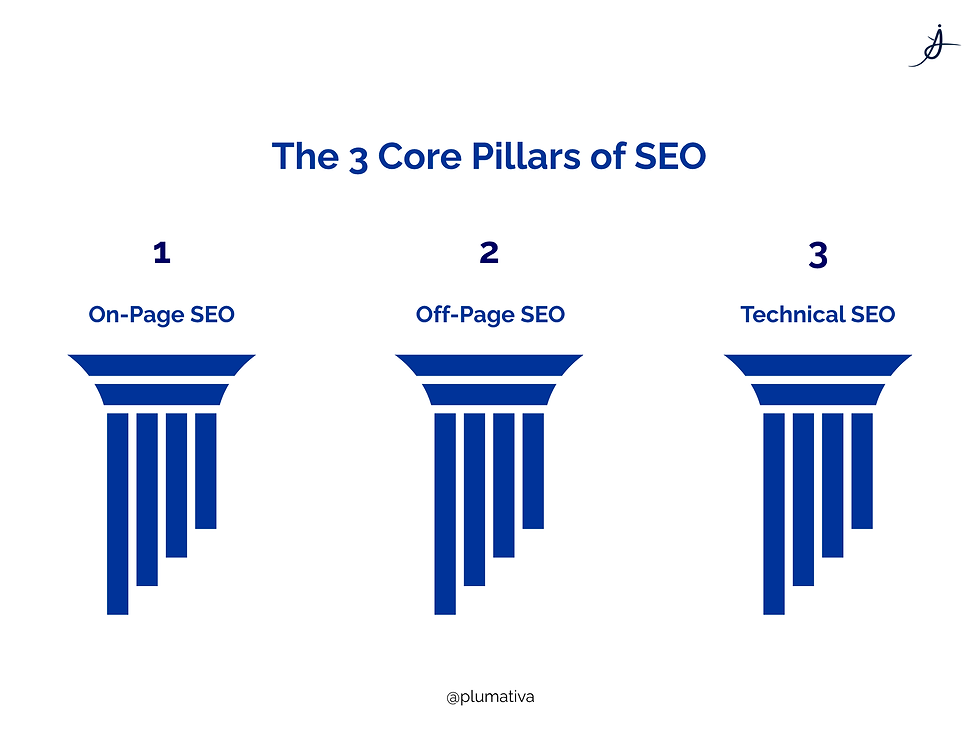
1. On-Page SEO: Optimizing What’s On Your Website
This is the SEO you control directly. It involves fine-tuning the content, structure, and HTML of your pages to help both users and search engines.
Key aspects of on-page SEO:
Keywords: Use the exact phrases people are searching for
Title Tags: The clickable headline that appears in Google
Meta Descriptions: The short summary under your title tag
Headings (H1, H2, H3): Organize your content for readability
URL Structure: Clean, keyword-rich, and user-friendly
Internal Linking: Connect your pages logically to pass value
Image Optimization: Use alt text and compress file sizes
Content Quality: Your content must be helpful, original, and easy to read
Search engines now use natural language processing (NLP) to understand meaning, context, and intent—so your content must answer the user's question, not just stuff in keywords.
2. Off-Page SEO: Building Authority and Trust
Off-page SEO refers to actions outside your website that impact your rankings. The main focus here is backlinks—links from other websites to yours.
Why backlinks matter:
They act as “votes” of confidence
The more high-quality sites that link to you, the more trusted your site becomes
Google sees these links as proof of authority and credibility
But not all backlinks are equal:
A link from Forbes or CNN is much more powerful than a link from a random blog
Spammy or low-quality links can actually hurt your rankings
Other off-page SEO factors include:
Brand mentions
Guest posting
Social media signals
Reviews and testimonials
Think of off-page SEO as your online reputation. The better it is, the higher you'll rank.
3. Technical SEO: Optimizing Behind-the-Scenes Performance
Even if you have amazing content, poor technical SEO can stop you from ranking.
Technical SEO ensures your website is:
Crawlable: Bots can access your site easily
Indexable: Your content is eligible to appear in search results
Fast: Google rewards pages that load quickly
Mobile-Friendly: Most users search from their phones
Secure (HTTPS): Google gives priority to secure sites
Structured with Schema Markup: Helps search engines better understand your content
This area usually involves developers or SEO specialists, but tools like Google Search Console can help you monitor technical issues.
What Are Keywords in SEO?
Keywords are the words and phrases people type into search engines. These are the bridge between what your audience wants and what your website offers.
There are different types:
Short-tail keywords: e.g., “shoes” – high volume but highly competitive
Long-tail keywords: e.g., “best running shoes for flat feet” – lower volume but higher intent
Branded keywords: e.g., “Plumativa branding agency”
Transactional keywords: e.g., “buy eco-friendly planners online”
You can find the right keywords through:
Google Keyword Planner
Ubersuggest
Ahrefs or SEMrush
Google Autocomplete
“People also ask” and “Related searches” sections
Great SEO starts with understanding what your audience is already searching for—then giving them exactly that.
How Long Does SEO Take to Work?
Let’s clear the myth: SEO is not instant. It’s not like turning on Google Ads where results come the next day.

The payoff? Sustainable traffic that keeps coming in without you constantly paying for clicks.
Can You Do SEO Yourself?
Yes, especially when starting. But SEO does involve a learning curve.
Here’s what you can do yourself:
Write high-quality, keyword-optimized blog posts
Use tools like Yoast SEO (for WordPress) to guide your on-page SEO
Submit your site to Google Search Console
Make sure your site loads fast and looks good on mobile
But SEO gets increasingly complex over time. When you're ready to grow faster, bring in experts to:
Create a solid SEO strategy
Perform detailed keyword research and competitor analysis
Run technical audits and optimizations
Build high-quality backlinks
Develop SEO-driven content that actually ranks
Many successful businesses use both SEO and SEM as part of their digital strategy.

Final Thoughts: Why SEO Is Worth It
SEO is one of the most powerful tools in digital marketing. It's not just about ranking—it's about connecting with people when they’re actively searching for what you offer.
Whether you're:
A startup wanting to get noticed
A local business aiming to get more leads
A content creator building authority
…SEO gives you the visibility and credibility you need to grow organically.
Need Help Growing with SEO?
If all this sounds like a lot—that’s because it is. But you don’t have to do it alone.
At Plumativa, we specialize in building search-optimized websites, crafting SEO-friendly content, and creating strategies that actually rank. Whether you need a full SEO audit, a keyword plan, or consistent content marketing—we’ve got you covered.
Let’s build your brand’s digital presence the right way—from the ground up.
Click here and let’s put your brand where it belongs—right at the top.
